No. 51: New in Outland: Runaway Models
Welcome to Soft Labor, the namesake publication of Soft Labor, a strategic consultancy for organizations, designers, and the culture industry led by Sarah Hromack-Chan. Did someone forward you this publication? Subscribe, read our archives, or email us at info@softlabor.biz.
Earlier today we published "Runway Models," the last of our six-part column for Outland, the namesake publication of an organization devoted to supporting initiatives in publishing and education that focus on art and technology. Sincere thanks to editor Brian Droitcour, who supported us in exploring subjects in which we have no formal expertise but decades' worth of personal interest. Today's column, for example, explores the relationship between technology (namely, AI) and fashion. Have a read.
In a recent Instagram ad for Meta’s glasses collaboration with Ray-Ban, a young woman perches on the edge of a water fountain in New York City, dressed in business drag while holding a paper sleeve of french fries. Tapping the side of her Rayban glasses twice with a smile, she commands: “Hey Meta, call Claire,” while glancing at the pigeon she is presumably snapping a photo of. “I have some gossip for you.” While we can only wonder what she has to tell Claire, the brand messaging is obvious: Wearing Ray-Ban Meta AI glasses enables professional and social success. She’s a girlboss!
The relationship between technology and fashion is a long and storied one, stretching all the way back to the late 13th century, when eyeglasses were first invented in Italy. It wasn’t until the 1960s and early ’70s that early prototypes of modern wearables emerged, including Hugo Gernsback’s “teleeyeglasses” that functioned as a TV set that could be worn on the face. The 1990s were a watershed decade: “Smart Clothes Fashion Show,” a 1997 runway show at Centre Pompidou featuring collaborations between the students and faculty at Créapole École de Création in Paris and MIT’s Alex Petland, married fashion and wearable technology—a precursor to the work of designer Hussein Chalayan, whose remarkable experiments with embeddable LED lights in fabric and robotic, kinetic garments shifted paradigms as they emerged around the turn of the millennium. These wearables differed significantly, both in form and function, from the mass-market devices that would arrive in the coming decades. The intersection of tech and fashion leads to diametrically opposed paths: Are such designs cyborg chic or distributed surveillance? Can wearable tech be a form of creative innovation or does it have to sell the idea of a frictionless lifestyle?
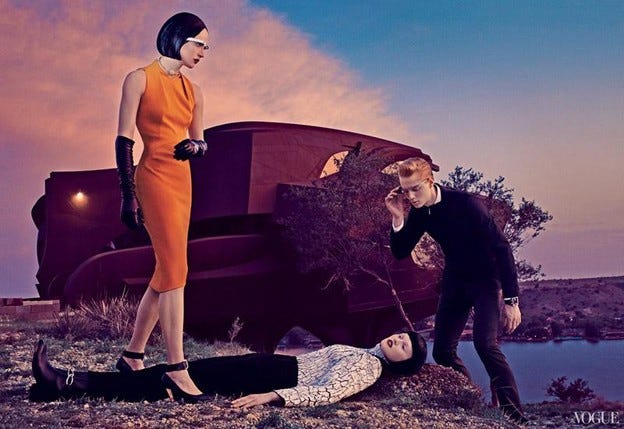
DVF Made for Glass, Dianne Von Furstenberg’s 2014 collaboration with the short-lived Google Glass, was the moment when fashion’s relationship to wearable technology arrived in a big, splashy, and highly risk-driven way, given how the device enabled voyeurism. Von Furstenberg was tapped to design frames for the notoriously awkward-looking glasses; the result was sold by luxury retailer Net-a-Porter until Google Glass was discontinued in 2015. At the time, Google Glass captured the imagination not only of technologists, but the fashion industry itself, as mainstream media outlets covered the project with a sense of amused wonder. Photographer Steven Klein’s 2013 editorial shoot for Vogue, “Final Frontier,” featured Google Glass in uncanny dystopian tableaux alongside the work of architect and artist Robert Bruno.
A decade later, the fashion industry is adopting AI at an explosive pace—one where the risk feels higher than ever as the technology itself is so all-encompassing. AI isn’t a one-trick pony.
Given Google’s fast, spectacular failure, it’s interesting that Meta would partner with Ray-Ban and Oakley to release AI-powered eyewear at a much more consumer-friendly price point. Likewise, Japanese eyewear brand Gentle Monster has also produced its own line of AI-enabled frames in collaboration with Google and Samsung. Adoption may go more smoothly this time because social media influencers now wield outsize influence, and they’re peddling these wares as they use them to document their aspirational lifestyles in real time as they traipse around lush, picturesque travel destinations.
Meanwhile, designers have been pushing boundaries by incorporating AI into the design process. Acne Studios was an early adopter, collaborating with artist Robbie Barratt to explore AI’s use in its men’s Fall/Winter 2020 collection. For Collina Strada’s Spring/Summer 2024 collection, creative director Hillary Taymour and her team fed images from their archive into Midjourney, producing the collection by guiding the model with text prompts. Strada’s collection was aesthetically unwieldy, signaling a refreshing appetite for risk. Known for her dedication to sustainability, Stella McCartney uses AI to design enzymes for textile recycling and machine learning to increase supply chain transparency. In the realm of high fashion, AI feels less a threat than an avenue for conceptual and operational agency.
That doesn’t mean that AI’s use in the fashion industry isn’t without the pitfalls that color so much of the discourse around the technology—especially where consumerism is concerned. Newer apps like Indyx and Stylebot use AI to help their users catalogue their own closets and suggest new outfits based on those holdings. These sorts of applications, intended for mass market appeal, beg the same set of questions: Is AI quickly diminishing the very sense of originality that makes thinking human? Do we really need an app to tell us how to wear clothing we chose for ourselves? Outsourcing everyday sartorial sensibilities belies not only a lack of self-confidence, but a poor sense of imagination, too. Regardless of the resources at hand, choosing what to wear is one of our most basic forms of self-expression.

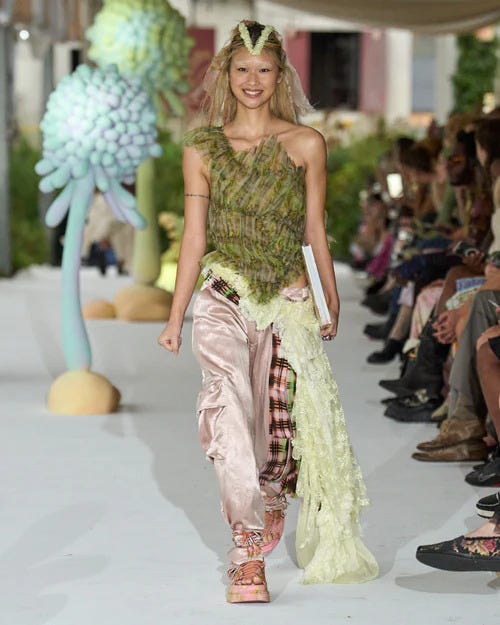
In a recent essay for Cultured, part of a series on the seven deadly sins, designer Dries Van Noten wrote about greed, arguing that when understood not in purely financial terms it can explain the pernicious impulse to optimize. “The tragedy of greed is that it slowly closes people up,” he writes. “It standardizes desire, tells us what to admire before we have had the chance to discover anything for ourselves. The algorithm decides what deserves attention. Everything becomes predictable, and we consume endlessly while feeling less and less.”
The broader, ongoing cultural conversation around the algorithm’s impact on personal taste can be felt in Van Noten’s analysis, which ultimately critiques the increasing lack of parity between creativity and business within the industry. Indeed, there is a true difference between using AI in a generative, boundary-pushing way as a designer or employing it on the business side to sell products with promises of imaginary lifestyles.
Perhaps the most treacherous aspect of AI is the existential threat it poses for the office worker and auteur alike. Everyone wants to be the director of their own destiny, and how one chooses to embrace or deny use of AI in one’s business or creative life is a vastly impactful decision, especially as we learn more about how AI use may alter aspects of cognition such as comprehension, memory, and information processing and retention. Where fashion and art are concerned, however, these ominous warnings might simply be red herrings that detract from the true creative possibility that AI presents if employed with the same degree of discretion, precision, and elegance that fashion embodies in its highest form.