No. 47: The Soft Labor Questionnaire: Brian Droitcour
Welcome to Soft Labor, the namesake publication of Soft Labor, a strategic consultancy for organizations, designers, and the culture industry led by Sarah Hromack-Chan. Soft Labor is a publication about creative labor—what it is, what it looks like, and how it has and will continue to change. Did someone forward you this publication? Subscribe, read our archives, or email us at info@softlabor.biz.
The Soft Labor Questionnaire, is simply that: A brief series of questions we’ve asked comrades in the field to answer about their own working experiences. Would you like to respond to the Soft Labor Questionnaire? Go right ahead and do so.
Today's respondent is Brian Droitcour. For the last twenty years Brian has been working in and around the art world as a critic, curator, editor, and educator. He has contributed to publications including 4columns and Rhizome, and has written catalogue essays for exhibitions at the Whitney Museum, the New Museum, and the Art Gallery of Ontario, among others. From 2014 to 2021 he worked at Art in America magazine, where he organized special issues on topics including the digitized museum, generative art, and immersive art. He has taught in MFA programs at Pratt Institute, Maine College of Art, the George Washington University, and City College of New York. Droitcour edited an online magazine for Outland, a fine art NFT platform, from its founding in 2021 to its suspension of operations in 2024. Last year he relaunched Outland as a nonprofit dedicated to initiatives in publishing and education about digital art.
Tell us about the first job you ever did for money.
The summer after my sophomore year of high school I worked at the family business, a machine shop, entering handwritten or typewritten records into the computer. It was really boring. The highlight of my day was lunch, when I'd play Solitaire or Minesweeper on Windows 95 while eating at my desk.
Is your current work related to what you studied in school? If so, how? Or, how not?
My undergraduate major was Russian language and literature, and I have a PhD in comparative literature. For I long time I used my language skills by doing freelance Russian-to-English translations, frequently for art institutions in Moscow. That work vanished after Russia invaded Ukraine in 2022, though last year I did have a couple translation gigs, for a museum in Kazakhstan and for the Zimmerli Museum at Rutgers, which has an important collection of Soviet nonconformist art. In general my work involves critical thinking and writing, so yes—I am using the skills that I cultivated as a student of the liberal arts.
What cultural touchpoint—music, art, literature, etc.—has informed your practice the most? How?
This is an interesting question! I've never thought about it in those terms before, but I'd have to say literature. I'm an art critic but I didn't study art history. After I finished college I moved to Moscow. It was my first time living in a big city, and it was there that I learned contemporary art was a field where people were engaging with ideas outside the ivory tower. So art's appeal had more to with the literary aspects of narratives and theory than its visual pleasure. I like to think that has changed over time, but I would say it has informed my practice the most.
What is the most rewarding aspect of working in your industry? The most challenging?
What I love about being a critic, as opposed to being a scholar, is that I can take on lots of different topics. Knowledge is always cumulative, and expertise grows over time, but it can be measured in breadth and not just depth. The most challenging thing is that society values any kind of expertise in the arts less and less, which makes it harder to find sustaining work.
Has AI impacted your work? How?
At some point in 2023 I decided to see if LLMs could speed up my writing process. I've always been a slow writer. I say I have "editor brain": the habit of thinking about how to improve other people's writing gives me a vicious view on my own. Most of the time I struggle to commit a fully formed sentence to the page because, as I try to choose words, I can't stop thinking about why they're wrong. My drafting process is a mess. I write for the sake of filling up the page, but it's all half-formed sentences and scattered notes. I go through this over and over again, punching it into something like an almost-publishable draft, to which I can then effectively apply my editor brain as I fine tune. Perhaps LLMs could get me to the draft stage more quickly, I thought. So I gave the LLM a prompt describing what I wanted to say, and the genre the text should conform to. I gave some notes on style and even made a folder of my past writings it could refer to. But the results were terrible. They'd be full of fake facts, and the model's attempts at imitating my voice felt like mockery. I adjusted my prompts but the results were no better. Useless, I decided.
Then, last summer, I had a draft that was close to being coherent but I felt totally stymied as I tried to revise. I remembered LLMs, and decided to give them another shot. Paragraph by paragraph, I put my rough text in, with some notes about what each chunk of the review was meant to accomplish. It organized my thoughts how I had wanted but couldn't manage on my own. It broke through the block. I still went through and edited the output, tweaking things and making sure all the facts had not been changed. But It was a lot better than what I got in 2023. Perhaps this could be attributed to improvements in the models. But I think it's mostly because I stumbled upon a more effective approach. The LLM is useful not as a writing machine but as an editing machine–a fancy autocorrect, a spellcheck that operates at the level of the paragraph. For almost a year now I've been using it this way on a regular basis. I write a first draft, then ask the LLM to sort things out. Sometimes the results are great–nearly ready to go with just a few tweaks. I strip away the hallmarks of generated prose–the lists of three things, the corrective comparisons, the ponderous subordinate clauses that it always tacks on to the end of sentences. Those are just bad writing anyway. (And yet, they are common features in art writing, which makes me suspicious that some of these AI companies availed themselves of the e-flux corpus that Alix Rule and David Levine used to define International Art English.) Sometimes the output is useless slop. Usually this is a signal that I didn't think things through thoroughly enough before turning to the robot for help. So I go back to my notebook and start again.
The LLM is not a writing machine, but an editing machine, and I don't give it total autonomy. I write, and I edit. I attribute the mindset that lets me think this way to my experience as an editor. Over seven years of working at an art magazine (plus several years working in digital publishing), there were many times when a writer sent me a document full of incomprehensible goobledygook, then rejected my gentle attempt to cajole them into writing what they had pitched. I would have to go through myself and shape it into coherence. I was paid a salary to do that. That was my job. It would be amazing if there were someone who got paid to transform my half-formed thoughts into polished prose. Alas! There is not. But the LLM can kind of do that. The LLM is the editor I've never had.
The debate around AI and writing tends to be very emotional. A lot of smart people reject it wholesale. So I do feel some shame around my use of LLMs. Then again, shame for me is often a default feeling (editor brain!). On some level I see where the anti-AI keyboard warriors are coming from. I don't think it makes sense to use an LLM to write literary fiction or poetry, where the author's decisions matter at the level of the word. But I see criticism and other kinds of analytical nonfiction as functional genres, where the most important thing is to get the idea across clearly. Critics who are especially precious their personal voice tend not, in my experience, to have much worthwhile to say about the work. The guilt I feel about using LLMs might also have something to do with the feeling of getting away with it. Since I started using them I still get compliments on things that I've published, and I don't say that LLM helped me, unless the conservation was already about LLMs, and I wanted to say "gotcha!" I haven't had an editor call me out on LLM use. I guess it's because I do a good job of hiding the trail. But also I find that most editors don't spend a lot of time giving feedback on my prose anyway. Which is why I use the LLMs in the first place.
This may be grandiose but I think I use LLMs more like a software engineer than like the people who pump out romantasy novels to spam Amazon's ebook market with. I have a practical goal: there's something I want to say and get to the public. I want my writing to be useful, like software. And my use of LLMs is about managing a workflow, rather than intervening in some kind of creative process. I think it's harder for most writers to think this way because writing, unlike coding, is wrapped up in the romance of the singular genius. Writers don't work in groups and have code review the way software engineers do, unless they're in an MFA program, where the goal is still to hone the individual voice. My work as an editor gives me an understanding of writing as a collaborative, polyvocal process. When I see writers whose work I've edited get compliments or grants for text with their byline that I wrote chunks of myself I don't feel the need to insert myself in the story; that's just what happens when you're an editor. And I like how LLMs offer a perspective on writing as a shared endeavor, an act that is always drawing on a large corpus of published and read texts. Even though I use LLMs to express ideas that I thought through myself, what matters is rendering them in a common language.
A postscript: Since relaunching Outland as a nonprofit mostly by myself, I have to produce a lot of administrative prose, and I find LLMs incredibly useful for this busy work. They're great at the soft legalese of partnership agreements, or turning a transcript of a board meeting into official looking minutes. These are things that would take hours to do on my own; LLMs make it possible to get them done and still have time to be a critic. They make it possible to run a critical institution. It's bad enough that my editor brain gets in the way of my writing. I don't need an administrator in there, too.
What advice would you give to someone starting a career in your industry?
Find a source of income that is not related to art criticism. I'm lucky to have had a staff job at an art magazine (Art in America, 2014-2021) but in retrospect it was stifling. I didn't grow much as a writer at that time because my primary concern was the magazine. I was more experimental, more open to new ideas and new ways of writing, in the years before I started working there, when I was making money from translation work and my grad student stipend. There are fewer jobs in art publishing and they are less desirable than they used to be so I wouldn't advise anyone to pursue work in that field.
What are you obsessed with that has little-to-nothing to do with "work"?
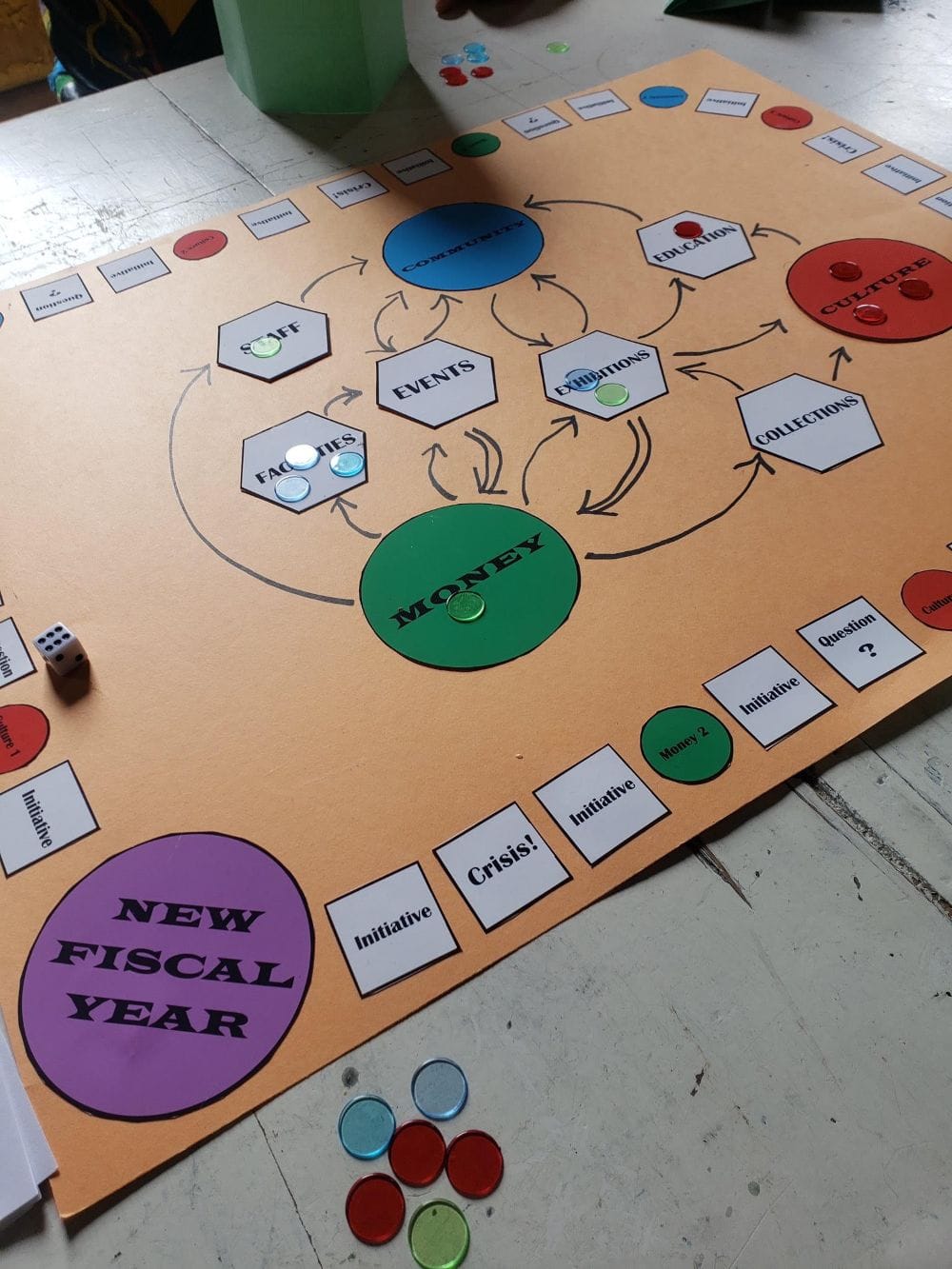
Dungeons & Dragons. I started playing as an adult in 2009, not that long after I moved to New York, and I've been participating in some kind of TTRPG ever since then. D&D was my primary social activity in the lockdown era of 2020 and 2021–collaborative storytelling was a lot more fun than Zoom happy hours. D&D has little to do with work, but not nothing. In 2012 I curated a group show with some thirty artists about role-playing games. In 2022 I designed a board game with role-playing elements about running an art institution. I just started a monthly series of events for people to play and talk about artists' video games. So I think a lot about games and their place in culture, and it's informed by my obsession with D&D.