The Last Soft Labor Questionnaire of 2025: Sarah Hromack-Chan
Welcome to Soft Labor, the namesake publication of Soft Labor, a strategic consultancy for organizations, designers, and the culture industry led by Sarah Hromack-Chan. Soft Labor is a publication about creative labor—what it is, what it looks like, and how it has and will continue to change. Did someone forward you this publication? Subscribe, read our archives, or email us at info@softlabor.biz.
The Soft Labor Questionnaire, is simply that: A brief series of questions we’ve asked comrades in the field to answer about their own working experiences. Would you like to respond to the Soft Labor Questionnaire? Go right ahead and do so.
Today's respondent to our last Soft Labor Questionnaire of 2025 is this newsletter's author, Sarah Hromack-Chan. Sarah is the founding principal of the strategic consultancy Soft Labor. She has envisioned and built creative teams in leadership roles at the Pratt Institute, the Whitney Museum of American Art, and design studio Project Projects, among others. Her writing about art, design, and technology is published online and in print; it has also been supported by an Andy Warhol Foundation Arts Writers Grant.
Tell us about the first job you ever did for money.
I hand-painted signage for local businesses in my Pittsburgh suburb as a tween. My father is a retired criminologist but his first degree is in graphic design, so he taught me how to paint letters freehand. It is not easy to do! In my office, I still keep an old-school steel tool box filled with his painting materials, including hand-made sable lettering brushes, along with a small collection of his art and design books.
Is your current work related to what you studied in school? If so, how? Or, how not?
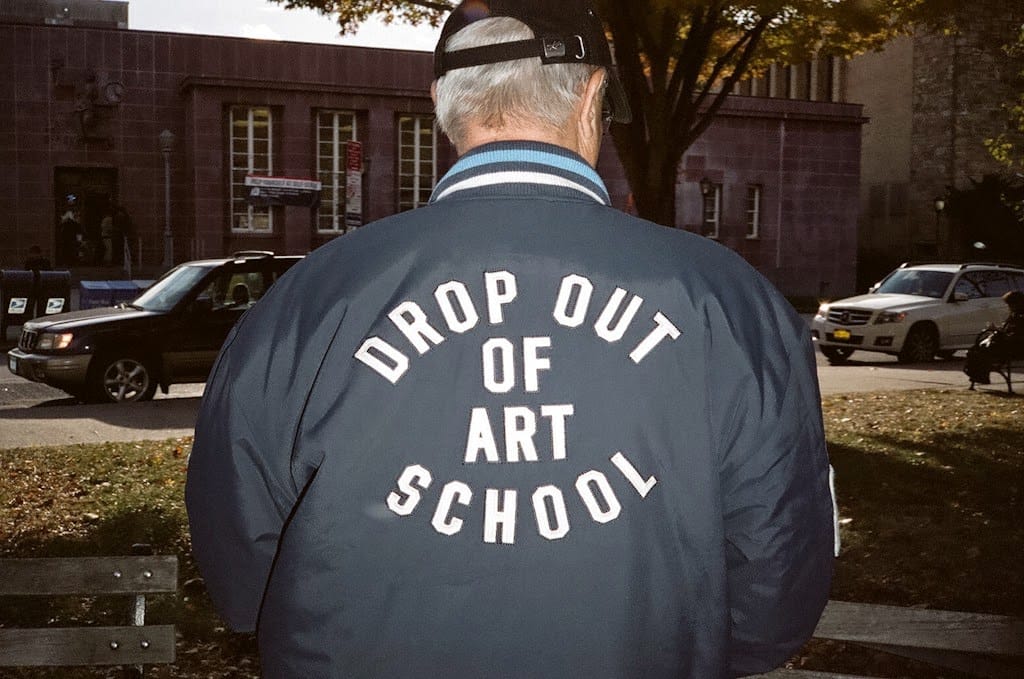
Yes. I studied fine arts and art theory, as well as visual and critical studies in undergraduate and graduate school, respectively, at capital A art schools in Baltimore and San Francisco. I mention this because I think the pedagogical dexterity or "looseness" of art school curricula—the ethos of art school and the particularities of these certifiably bananas cities—had an enormous impact on me as a person. I joke wryly about art school: I earned my math and science credits by playing with a lot of gold leaf while studying art conservation in Florence, for example. Yet, I learned how to think deeply, critically, and in new and novel ways by studying in American and European art schools in the ripeness of the 90s and early aughts. I cherish that ability and have carried it into everything I've ever done professionally. I also began blogging during those years which was, for me, fundamentally about self reliance through independent publishing back when the Internet was run by humans.
What cultural touchpoint—music, art, literature, etc.—has informed your practice the most? How?
The early social Internet. The American Rust Belt. Mike Kelley-grade suburbia. D.I.Y. culture. Institutional Critique. Local libraries. Magazines. Motherhood.
My animus and my wanderlust is rooted in the experience of growing up without sidewalks!
What is the most rewarding aspect of working in your industry? The most challenging?
The so-called culture industry is a tricky space to work in as has so many distinct nodes, yet can feel utterly amorphous. One must truly believe in one's own ability to forge a professional path forward, and that sense of confidence can be difficult to maintain over time.
I recently began mentoring with the New Museum's cultural incubator, NewINC, and collaborating with other creative people in that way is enormously gratifying. I've always loved teaching, too. I've mostly worked with graduate students, but as an undergraduate I taught art in a kids' after-school program in the Baltimore City public school system. It was some of the realest work I've done to this day and schooled me harder than any book or seminar possibly could have at the time.
Has AI impacted your work? How?
Yes, in that it has become a subject for intellectual fodder. As for my own writing, I do not use LLMs to produce prose as I deeply love the quirks inherent to my own syntax—and to my deployment of punctuation—and want to maintain them for as long as possible. Like them or not, my flagrant em dashes are the real deal, people.
(Here's a pretty comprehensive, yet scaremongering New York Times feature by Sam Kriss about the way AI is changing writing. "The Em Dash Responds to the AI Allegations" is a future Mc Sweeney's classic. I also love N+1's recent rant on the subject.)
What advice would you give to someone starting a career in your industry?
This is very difficult to do early in your career, but I would advise people to allow their inner sense of self to guide the development of their professional identities—not the other way around. I'm also big on maintaining a strong sense of ethics in one's everyday work. Live your politics.
What are you obsessed with that has little-to-nothing to do with "work"?
Fashion—mostly independent designers and street looks over luxury, save for my well-documented obsession with Japanese design. Psychology. I read broadly, too.
Bonus obsession: The relationship between decreased screen time and increased mental cognition. For 2026, I've purchased an absurdly expensive Hobinichi Techo paper calendar and plan to manage myself manually because I know that information is better encoded and recalled by the brain when written by hand. Anyone that works with me witnesses the black, alligator skin zip-up notebook that I schlep around and scribble in. It‘s a little pretentious, but I love it.