New in Outland: Escape Hatch (why museums must embrace contradiction in a time of crisis)
Welcome to Soft Labor, the namesake publication of Soft Labor, a strategic consultancy for organizations, designers, and the culture industry led by Sarah Hromack-Chan. Soft Labor is a publication about creative labor—what it is, what it looks like, and how it has and will continue to change. Did someone forward you this publication? Subscribe, read our archives, or email us at info@softlabor.biz.
Our latest piece just published in Outland, the publication produced by Outland, a new, nonprofit organization dedicated to publishing and education in the field of art and technology. We've been invited to contribute a monthly column about encounters between institutions and new media, and the shifting meaning of digital work.
In our third column, "Escape Hatch," we consider why and how museums must embrace contradiction in times of crisis. Thanks to Outland editor Brian Droitcour for encouraging us to republish the piece in its entirety below. Be sure to subscribe to Outland on Substack!
What should museums do in a moment where people of all ages are eschewing—or at least trying to eschew—their screens? What does it mean for museums to activate visitors’ devices to deliver wall texts and audio guides when these devices themselves are direct portals to social, political, and cultural crises? Has the “digital engagement” of games, app-guided tours, museum selfies, and hashtag humor that was hyped so hard in the 2010s locked museums into strategies that point toward irrelevance when viewed against contemporary concerns like screen addiction, digital fatigue, and surveillance capitalism? One could argue that museums need to play an enhanced social role in a cultural moment like this one, even as public trust in institutions erodes.
Criticism starts at home and I live and work in New York City. Visiting my local major museums, I notice the ways in which lobbies, cafes, museum stores, and the wares they sell are physically refashioned at the frequency of the art fair calendar, presumably to meet the changing desires of the entertainment and spectacle-seeking public. Museums tend to look inward when considering market competition, measuring themselves first and foremost against other institutions rather than other industries, even as they take external cues from fashion and tech, both of which continue to support the arts through well-funded residencies, programs, and awards, such as the Chanel Next Prize, or Hyundai Artlab.
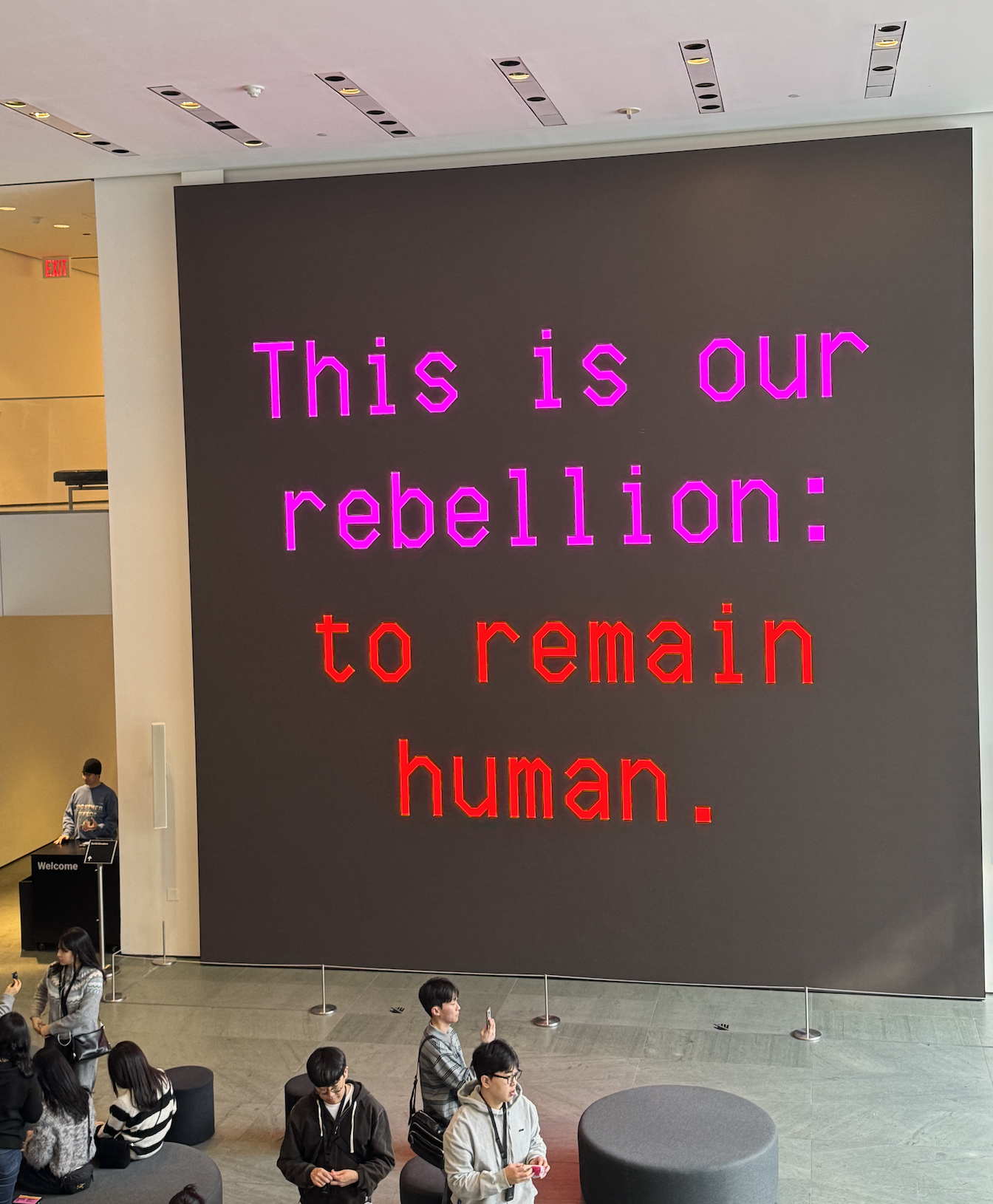
I can’t help but turn to the Hyundai Card Digital Wall, a Times Square-scale screen that has dominated the lobby at the Museum of Modern Art since 2022, transforming it into a shapeshifting sound-and-light bath for museum visitors. Criticism—and there has been plenty—tends to focus on the artists whose work has been displayed there. But I’m more interested in the screen as public policy, as an entity that defines the lobby experience. Much current research tracks a desire to retreat from technology; social psychologist Clay Routledge wrote in the New York Times about Generation Z’s obsession with the 1990s and its relative lack of technological overload as an example of a phenomenon known as “historical nostalgia.” And yet, as MoMA visitors huddle around the lobby’s open seating plan, scrolling and snapping selfies, the screen remains the organizing principle for public space.
Overcoming this contradiction will take some serious reflection about the state of culture. Office of Applied Strategy (OAS)—a combination consulting firm, think tank, and venture fund—recently published The New Pantheon, a research dossier exploring the concept of “Horseshoe Maximalism.” As OAS founder Tony Wang writes in the introduction, this term describes a culture that deliberately embraces the contradiction of a hyperpolarized world rather than attempting to resolve it. The essays in The New Pantheon consider how people are responding to a collapse of trust in institutions and progress across a dizzying array of examples, from gamification and gambling to fringe wellness practices and doomsday prepping.
Museums aren’t addressed in The New Pantheon, but I think we might find them in the depths of the horseshoe’s curve. Trump is relentlessly attacking the Smithsonian, and federal funding restrictions have sent shockwaves through creative communities nationwide. Yet museums still see themselves as bastions of culture. They imagine that their programs reflect the zeitgeist, as it is identified through the expertise of their curators and program directors. Historically, museums don’t embrace polarization; they ignore it altogether.
But museums can no longer hold themselves above the fray. Their sense of institutional self-assuredness is part of the problem in a moment as dark as the one we’re living in. If they are to remain relevant, museums can’t simply rest on the laurels of art history while assuming that their role of cultural stewardship is legible to those beyond the institution. This isn’t a new critique of museums, but it is an urgent one now.
Museums could learn from what OAS consultant Helen Yin Chen identifies as “pericultural” third spaces: “relational environments that exist within and outside of cultural norms” that emerge in marginalized communities. For Chen, such spaces transform what OAS calls “dark cultural matter” of precarity into a form of solidarity by embracing contradiction. Chen cites skateboarders, sex workers, and seed stewards as three examples of subcultures that embody this behavior.
Can you imagine skateboarders taking over the steps of the Met? I’m sure folks have tried. Can you imagine a day traipsing around MoMA after dropping your phone at the door for safekeeping? I can. And these might be ways for museums to embrace precarity rather than position themselves as agents of neutrality above, outside, or beyond it. After all, isn’t this what programming and education initiatives already do by inviting various practitioners and publics inside museums’ hallowed halls? A very recent example of this is “Education as Resistance,” artist-run platform LA ESCUELA___’s collective learning project that transformed MoMA PS1’s Homeroom gallery into a shared learning space charting artistic pedagogies from across Latin America, the Caribbean, and their diasporas. At the cost of fifteen dollars per ticket, MoMA’s recent series of Artist Parties are another, lighter example of programming that has drawn fantastic crowds of New Yorkers. Individual lectures, performances, and activities create temporary third spaces throughout the museum, offering new inroads into the museum’s exhibitions while extending its institutional range.
Museums need to accept polarization and precarity even as they resist it. They need to recognize that an institution must do both in order to do either well. More than anything, museums can and do provide places for us to slow down and think at our own pace. Some of what they do best, in fact, is allow people of all generations to imagine history that we haven’t experienced.
Unfortunately, museums most often do this in a Polyannaish way, marketing themselves as ways to escape the chaos of digital media through linear, object-driven art historical models. Instead, museums should be offering distance that allows for critical engagement with the present, which is impossible to parse from the past.
MoMA’s lobby screen, programming aside, is the worst of both worlds. It simply accepts the screen’s dominance of social life while using it as a vehicle for its stewardship of contemporary art. The screen itself renders MoMA’s lobby as a space where visitors can meet up, greet one another, and lounge, all while bathed in the relentless light of contemporary art, which might not even register as art to some, regardless of its location within the museum.
This insipid embrace of technological coziness—a massive screen coddling those of the visitors who sit beneath it—might make the MoMA lobby more of a trap than an escape hatch. The sheer hegemonic weight of the Wall itself overshadows the individual world of screen addiction that each visitor below inhabits. Watching folks idling around, phones in hand, one can’t help but wonder if the dominant experience isn’t just one long, relentless scroll into cultural complacency. The scary part is how comfortable it feels to just sit there, lost in time and space.